

Robert Macoy and the "Missing Link" of Masonic Knighthood
Compiled by Steve McCall, owner of Macoy Publishing & Masonic Supply
The Curator’s Discovery (Steve gave himself a new title)
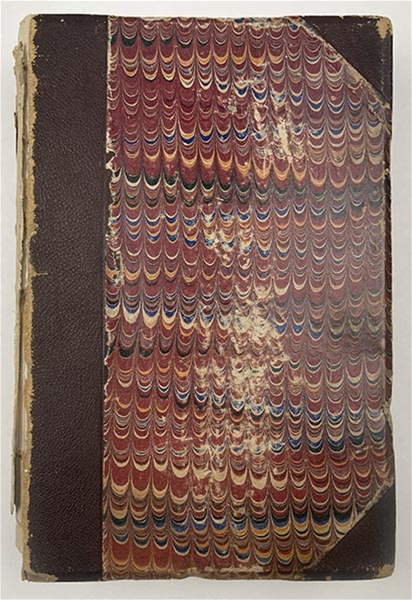
In our archives (it’s my office and another room with boxes full of books) at Macoy Publishing, we recently revisited the 1873 edition of The Knights Templars. C.G. Addison wrote his original work The Knights Templars in England in the early part of the 19th century. It was at the time, considered the source on the Crusaders. In the middle of the 19th century, Robert Macoy (33°) realized it was missing the most crucial element for our fraternity: the direct connection to Freemasonry. Macoy didn't just republish a history; he "enlarged" it to bridge the gap between the medieval Crusades and the modern American Commandery.
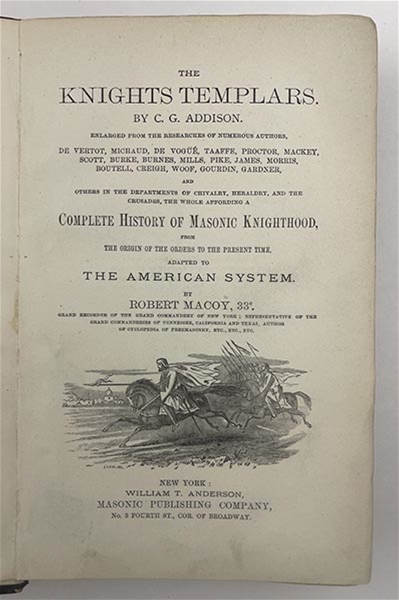
Look at the title page of the book. Geesh. Ok we get Robert. You worked hard and read a lot of books from a lot of authors. (Kinda braggadocios)
3
Distinguishing Claims from the Macoy Preface
1. The "Transfer of Spirit" Theory
Unlike
non masonic historians who see the end of the Templars in 1312 as a finality,
Macoy argues for a continuous lineage.
"Our
closing portion [reviews] the History of the Military Orders from the
extinction of Knight Templary as a Papal Order... to the transfer of its forms
and spirit to the Masonic Fraternity."[1]
Why it
matters today: This clarifies that we don't necessarily claim the Crusaders started
Freemasonry, but that the Masonic order became the designated
"custodian" of their chivalric values. These values to the profane
world are tainted with image of Christians slaying others in the name of
Christ. But in this book, both Addison
and Macoy highlight why The Holy Land was important to people of the high middle
ages. This is not to make an excuse for
any war. It is give you an understanding why Christian Soldiers would go to the
Holy Land and why Knights Templar masonic order would so resonate with
Freemasons in the 19th century.
2. The Three Orders as One Brotherhood
Macoy
makes the bold claim—citing earlier scholars Preston and Laurie—that the
medieval Knights were actually Freemasons themselves.
"The
compiler has also inserted numerous Masonic allusions... following the
theory... that the Monks of the three great Military Orders, viz: Templars,
Hospitalers, and the Teutonic Knights, were Freemasons."
Why it
matters today: For the individual student or seeker, this suggests a shared
intellectual and spiritual DNA between all the branches of chivalry, rather
than viewing them as separate, competing groups.
As
most masons are taught or hear at the opening and closing of most lodges,
“peace and harmony being strength and support of all institutions, more
especially, this of ours.” Macoy again sees “the forms and spirit” of
chivalry was shared amongst all the knights regardless of their differences.
3. The "American System" of Chivalry
Macoy
believed that the "American System" was the most glorious evolution
of these ancient ideals. In 1873, he counted over 30,000 swords stored in 500
American armories, all emblazoned with the Templar’s Cross. It is important to
understand there was a type of “Holy Land Mania” going on America in the 19th
century. Writers attribute this to a
desire to connect with biblical history, fueled by evangelical Protestantism,
increased travel capabilities, and a search for “authentic” roots of their
faith.
Why it
matters today: It reminds us that being a Knight Templar in the United States is a
commitment to a specific 19th-century standard of chivalry and Christian values
that Macoy helped codify. Macoy quotes
Montaigne[2],
“The age of chivalry indeed is gone. We have piled away its helmets and its
spears : but its blazonry is invested with a more poetic charm. Still we love
the past. We love the heroic in man's history, we hate to divest it even of its
fictions. The independent spirit of chivalry, bent on the accomplishment of
lofty ends, without calculation of chances, or fear of failure,
so
generous in action, so munificent in courtesy, so frank in friendship,
and so
gallant in danger, must ever have rare attractions to the enthusiastic
and the aspiring.”[3]
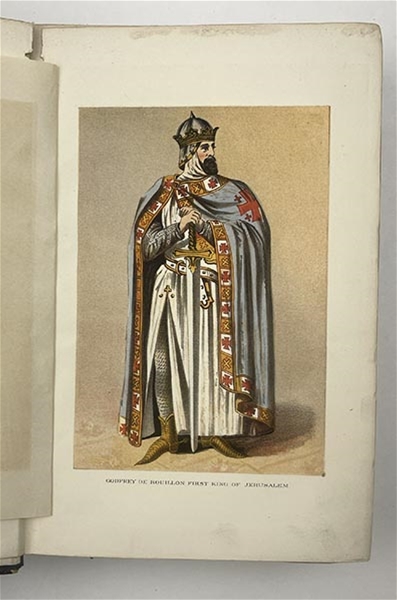
Watch the video as we show the 1873 book.
[1]
Addison and Macoy, The Knights Templar (Masonic Publishing, 1873), 10-12
[2] Michel
de Montaigne was a French philosopher.
[3]
Addison and Macoy, 11
Shop Knights Templar Education & Jewels
Macoy Publishing & Masonic Supply specializes in the "Mastery of the Order." Explore our curated selection of Templar essentials:
- Knights Templar Illustrated: The definitive guide to Commandery ritual, history, and floor work.
- Templar Jewels & Pins: High-quality Cross and Crown pins and rank-specific jewels.
- Masonic & Templar Rings: Fine jewelry featuring the freemason logo and Chivalric emblems.
Why Macoy is the Intellectual Home of the Commandery
While other suppliers may focus on mass-produced clothing, Macoy Publishing & Masonic Supply focuses on the soul of the organization. Since 1849, we have known that being a Knight Templar is an intellectual and spiritual commitment. Our 175-year history as a publishing house means we offer the "Standard" by which others are measured. When you seek the truth behind the Templar cross, you turn to Macoy. We provide the tools to help you truly *understand* the Commandery, ensuring the light of Chivalry never goes out.
