

The Winding Stairs and Middle Chamber
The Fellowcraft
degree is a greatly misunderstood one. Possibly it would be more correct to say
it is a greatly “un” understood one. We
do not get the significance of the Fellowcraft degree--we miss some of the most
important lessons in Freemasonry when we do not give to this degree the same
study that we give to the other degrees. When we do not give to it the study
that will place it in its rightful niche in the scheme of Freemasonry.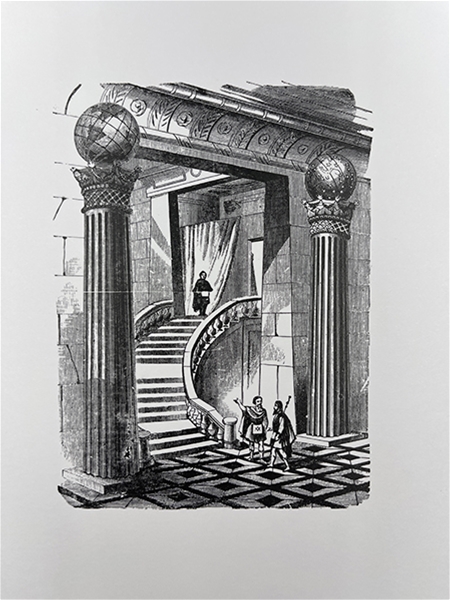
Instead of
being a buffer degree, as it so often is considered to be-instead of being
something to bridge a gap between the beginning and completion of Craft
Freemasonry, the Fellowcraft degree presents opportunity for employment to the
fullest of all the faculties of the most studious-the most erudite-and
motivates us to make full use of those faculties. A study of Freemasonry of the
pre-Grand Lodge era seems to leave no least doubt that the Fellowcraft degree
was once the ultimate in Freemasonry, and was the highest degree until shortly
after the formation of the premier Grand Lodge in London in 1717. A Master's
part was included in the early Fellowcraft ritual, and this part may have
provided the framework for our present Master Mason degree. At any rate, it
seems the Entered Apprentice labored seven years with freedom, fervency and
zeal, presented his Master's Piece and became a Master or Fellow of the Craft,
and there was nothing higher. There seems no doubt that, until well toward the
Grand Lodge era, there was little ritual for the Master's or Fellowcraft part. It
probably would be more accurate to speak of it in that early period as a grade,
rather than a degree.
Approaching the
Grand Lodge era there seems to have been some elaboration of the ritual and the
degree was conferred infrequently in district meetings. There is authentic
record that there were several times as many Entered Apprentices never advanced
from that grade. When, shortly after the formation of the premier Grand Lodge,
it seems the Master's part was taken out of the Fellowcraft grade and made a
separate grade or degree, and it was for some years conferred only in Grand
Lodge. The Fellowcraft degree, conferred usually, or at least frequently, in
district meetings, and the Master Mason degree, conferred only in Grand Lodge,
were the higher degrees. The manufacture of the so-called higher degrees as we
know them today had not yet been started, and the degree mill was yet to be
invented. Proof that the Fellowcraft degree once was the ultimate is found in
the fact that our three principal officers wear as their jewels the Working
Tools of the Fellowcraft, the Square, Level and Plumb. These jewels were
adopted at the formation of the premier Grand Lodge in June, 1717, before there
was a third degree, and when the Master degree was evolved, or added, the
officers continued to wear the jewels already assigned them.
The Fellowcraft
degree may be embellished with anachronism, and certainly it is replete with
inconsistency. The candidate may be confused by what may (to him) seem to be
purposeless instruction and incident. But, through the years, if he gives
serious attention to his Freemasonry, he will become convinced there is nothing
purposeless in Freemasonry. Anachronism and inconsistency should be a challenge
to the inquiring mind, which the Fellowcraft degree is admirably designed to develop.
The more enigmatic the allegories and symbols, the greater the joy that comes
from their interpretation.View anachronism and inconsistency as merely a part
of a vehicle which sustains the allegories and carries the symbolism by which
beautiful lessons are inculcated, then anachronism and in-consistency may be
wholly and completely dissipated by disregarding the vehicle and giving
attention to that with which the vehicle is freighted.
It seems to me
to be an error to leave our votaries in complete, or almost complete, ignorance
as to the place of this degree in the scheme of Freemasonry. I have said some
believe it to be something sandwiched between the Entered Apprentice degree and
the Master Mason degree as a filler. In a way that may be true, but what is the
filler in the middle of a sandwich? The meat. The Fellowcraft degree seems to
be the meat of the Masonic sandwich.
First, I shall
discuss briefly the principal allegory of the degree.If I develop anachronism
and inconsistency, I hope later to dispel such.
In a manner
familiar to all Fellowcrafts, the candidate receives instruction relative to
the Pillars, the several Orders of Architecture and is impressed with the
importance of a study of the liberal arts and sciences, especially the noble
science of Geometry. The candidate must feel there is some significance to the
Pillars, to the Winding Stairway, to the several Orders of Architecture, to the
liberal arts and sciences, to the Middle Chamber, to the wages and jewels of a
Fellowcraft Mason-some mystery about them that he is not grasping. He must be
mystified and desire interpretation that he does not receive. Should we leave
our votaries wondering what it is all about?
The candidate,
if he is giving attention to the instruction he is receiving, cannot be greatly
blamed if the thought strikes him that those conferring the degree and those
sitting in the body of the lodge-men with whose activities he is familiar-have
not distinguished themselves by practicing the lessons being presented to him. It
is not likely that the candidate will become enthused about a study of the
liberal arts and sciences, about the five senses, about the several Orders of
Architecture, about the wages and jewels of a Fellowcraft Mason. And, from his
association with those he sees in the body of the lodge, the thought may strike
him that they know no more about those things than he does-who has just become
a Fellowcraft-and some of them possibly not so much. At the time he may wonder
how he is to become informed, but, if an average Freemason, he soon will follow
the example of those who have gone before him and will cease to be even curious
about the things that puzzled and intrigued him.
Are we fair to
our votaries when we present the beauties of the Fellowcraft degree to them and
then provide no way by which they may enjoy those beauties? Are we Freemasons
of many years doing our part in enabling the new Freemason to get out of the
Fellowcraft degree what there is in it?
The new
Fellowcraft is likely to accept literally everything he is told by his
instructors about King Solomon, his Temple and the things supposed to have happened
while the Temple was building. Fact and fancy are so cleverly intertwined, so
cleverly inter-woven, that all may be accepted as fact.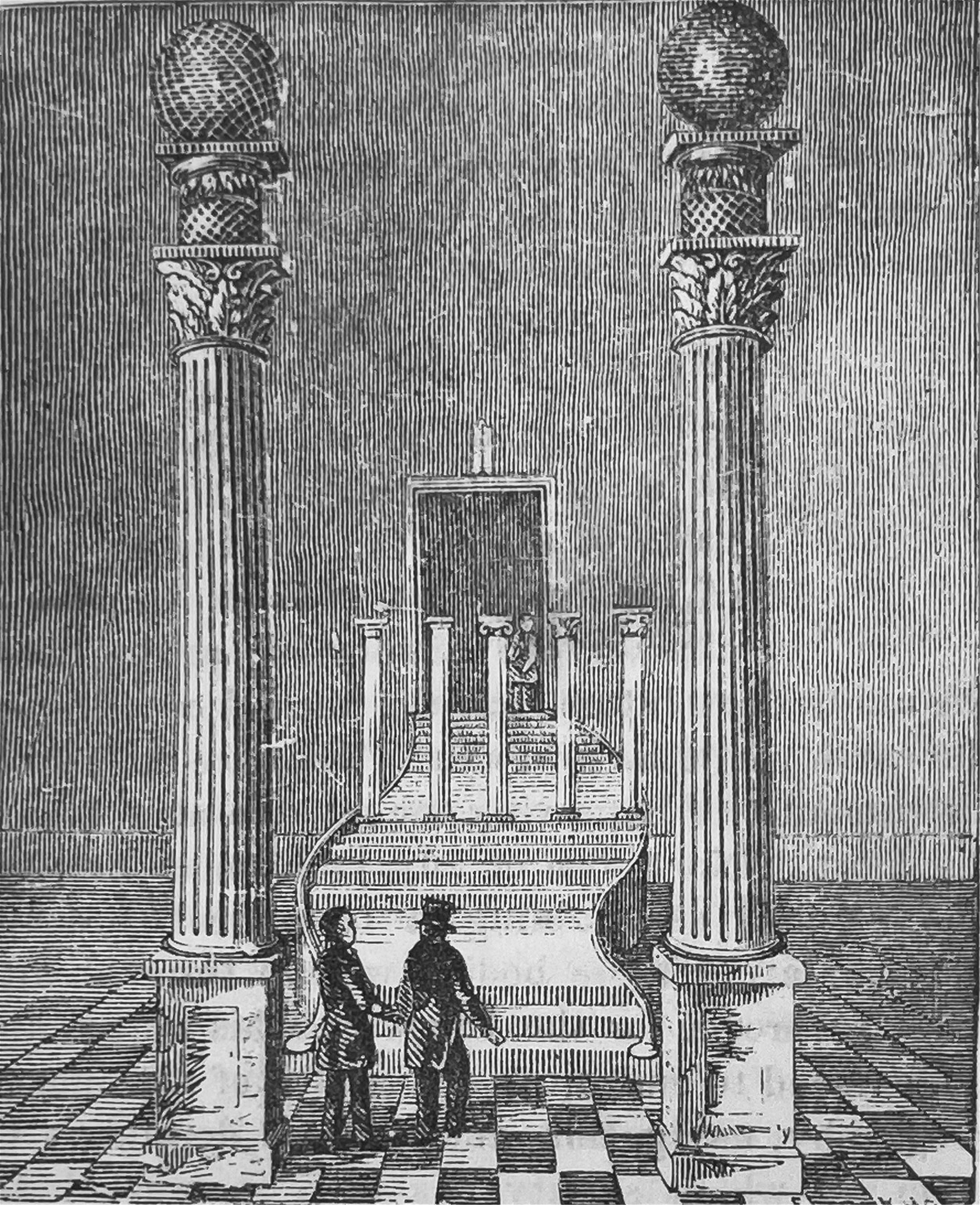
When the
Pillars are explained, the inconsistency in their description is not likely to
occur to the candidate. It is not likely to occur to him that no one living in
the time of King Solomon had ever even heard of the continents of the western
hemisphere and certainly had no idea of the shape of continents of which they
had never heard, nor knew the shape of continents which they knew to exist. It
is not likely to occur to the candidate that it was 24 centuries after the
building of King Solomon's Temple that Columbus decided to discover America to
prove that the world was round.
It seems to me
that, early in the life of the Fellowcraft, we should teach him not to worry
about inconsistencies and should explain, so far as we can, the purposes of the
various inaccuracies in the degree he has received, at the same time encouraging
him to find explanations of his own.
No one today is
certain what purpose the Pillars served, or what they represented. They did not
sup-port any part of the Temple, as they were, according to the Volume of the
Sacred Law, placed on the porch, which seems sufficient evidence that they were
not built into the Temple. If they served no useful purpose, and were largely
ornamental, weren't they symbolic of some Freemasons we have today? If the
Pillars were repositories, as has been suggested to us, it seems no way was
provided for getting to and using the information they contained. That may
sound ridiculous, but don't we today refuse to make use of information we know
to exist?
When the
candidate first learns what we may read in any description of the Fellowcraft
degree, that, on pay day 80,000 Fellowcrafts climbed a narrow stairway to the
Middle Chamber and carried away a great bulk in wages, he is likely to be
considerably mystified. He hasn't yet learned much about allegories, but if he
realizes that the Temple was not larger than some unpretentious Masonic Temples
of today, he may wonder how more than a few hundred of the 80,000 could have
been accommodated. Wouldn't we be happy today if we could have such numbers
trying to crowd their way into our Temples on meeting nights?
I have given
some of the impressions a candidate is likely to have-some of the impressions
I, myself, had. I shall now tell you some of the things that have come to me
through the years. I shall attempt to dissipate the inconsistencies which I
have developed, and I may astound some with my initial statement that to me the
Winding Stairs and Middle Chamber are wholly and completely philosophic myths.
There is nothing historical to indicate they ever existed as a physical part of
the Temple proper. They are to me merely a part of one of our prettiest
allegories. They are necessary as the vehicle by which the allegory is
sustained. The fault of most of us is that we give all our attention to the
vehicle and fail to see that with which the vehicle is freighted. As I have
said, to me, the Winding Stairs and Middle Chamber are philosophic myths, but,
as symbols, ah! that is something else! As symbols, they are very real to me
and have a charm all their own. They hold lessons that might be presented in no
other way, lessons that have become apparent to far too few of us.
The Fellowcraft
degree now becomes a glorification of education, the acquiring of knowledge.
Haven't we been impressed with the importance of a study of the liberal arts
and sciences? What was meant by that except to admonish and urge us to acquire
knowledge? As the years have hurried by I have learned that the seven liberal
arts and sciences are not the septa-headed dragon that, to the candidate, they
no doubt seem to be. They are grammar, logic, rhetoric, arithmetic, geometry,
music and astronomy. Few Freemasons may hope to become versed in all of these,
and Freemasonry does not ask that they shall. On the other hand, it would be
impossible to acquire any kind of usable education without drawing from several
of these arts and sciences, particularly grammar, logic, rhetoric and
arithmetic. Many of us make daily use of these without realizing that we are
doing so. I could not be giving this address without drawing upon several of these
liberal arts and sciences. My original conception of the liberal arts and
sciences as something formidable was long ago dissipated.
 The Fellowcraft
has advanced from the Entered Apprentice degree, symbolic of youth, and stands
at the threshold of the Master Mason degree, symbolic of later life. The
Fellowcraft degree, therefore, is symbolic of middle life-the period for effort
and study-the period that should be the one of the greatest mental activity,
the period for accomplishment. It is possible that the time taken to impress
the candidate with the importance of a study of the liberal arts and sciences, and
of making use of the knowledge therein contained, is wasted upon many. Possibly
the allegory of the Winding Stairs has led few to such a study, but Freemasonry
has done its part. It has admonished and it has furnished the vehicle. It has
done its utmost to create in its votaries a desire for knowledge. Certainly the
allegory of the Winding Stairs teaches that study of the liberal arts and
sciences-that increase of knowledge-leads onward and upward. Hardly could there
be a more important lesson in Freemasonry, or elsewhere.
The Fellowcraft
has advanced from the Entered Apprentice degree, symbolic of youth, and stands
at the threshold of the Master Mason degree, symbolic of later life. The
Fellowcraft degree, therefore, is symbolic of middle life-the period for effort
and study-the period that should be the one of the greatest mental activity,
the period for accomplishment. It is possible that the time taken to impress
the candidate with the importance of a study of the liberal arts and sciences, and
of making use of the knowledge therein contained, is wasted upon many. Possibly
the allegory of the Winding Stairs has led few to such a study, but Freemasonry
has done its part. It has admonished and it has furnished the vehicle. It has
done its utmost to create in its votaries a desire for knowledge. Certainly the
allegory of the Winding Stairs teaches that study of the liberal arts and
sciences-that increase of knowledge-leads onward and upward. Hardly could there
be a more important lesson in Freemasonry, or elsewhere.
What do the
Winding Stairs and Middle Chamber symbolize to other Fellowcrafts? That I do
not know. That is for each to determine for himself. To me, they symbolize
everything desirable in Freemasonry, and even more-ascent from a lower level to
a higher level known only to Freemasons-ascent from the darkness of ignorance
to the light of knowledge-ascent from error to truth-ascent from death to
life-progress from enjoyment of common things to desire for higher
things-progress from adolescence on through active years of middle life when
attention must be given to acquiring those things which bring security, joy and
contentment in the mellow years of age- development of friendship-increase of
knowledge -all the better, nobler and more desirable things of life and of
Freemasonry.
The fact that
the stairway winds teaches us that we must strive upward by devious ways, that
we must strive upward step by step, that we must strive upward to an unknown
goal, that we must strive upward toward light, knowledge and success without
looking backward to the darkness of ignorance and failures of the past. The
division of the stairs into three, five and seven teaches us that through
successful conclusion of one task we have merely prepared ourselves for a greater
task.
 A straight
stairway hides neither danger, nor secret, nor mystery, but the Winding Stairs
of life lead to we know not what-for some, to a Middle Chamber of fame and
fortune; for others, to a Middle Chamber of pain and frustration. The Winding
Stairs symbolize our way through life-and the Middle Chamber, the place at
which we hope to arrive by our own endeavors, a virtuous education and the
blessings of God.
A straight
stairway hides neither danger, nor secret, nor mystery, but the Winding Stairs
of life lead to we know not what-for some, to a Middle Chamber of fame and
fortune; for others, to a Middle Chamber of pain and frustration. The Winding
Stairs symbolize our way through life-and the Middle Chamber, the place at
which we hope to arrive by our own endeavors, a virtuous education and the
blessings of God.
The wages of a
Fellowcraft teach me that we shall be rewarded according to our deserts-that
greater efforts bring greater rewards-that by honest toil we provide ourselves
with the nourishment which our efforts have made necessary-with the joy that
comes from knowledge of a task well done. Fellowcrafts should remember that it
is not so much what or how much we get, but what we do with it after we get it.
Some other
brother may find something relative to the Winding Stairs and Middle Chamber
that has escaped me where I have searched. He is not restricted to what I have
found, nor to what any other brother finds, nor to what he himself finds, nor
to any one interpretation of a symbol or an allegory, nor can he ever to
himself say he has discovered the full meaning of any symbol or allegory.
Freemasons, newly-made and those who for years have sat within the Tyled Circle,
are losing much of the beauty of Freemasonry when they do not brush aside the
veil of allegory and by their own efforts give life and virility to the truths immortal
and eternal which have been presented to them in the Fellowcraft degree. We
should follow the Winding Stairs to hidden knowledge in the Middle Chamber.
Regardless of
any interpretation I may give-or any brother may give-to the Winding Stairs,
they should at least lead us SOMEWHERE-possibly to the Middle Chamber of a
spiritual building-possibly to a fuller appreciation-a better understanding-of
the beauties of the neglected, misunderstood, and- “un” understood Fellowcraft
degree.
There IS a Middle Chamber. There ARE wages of a Fellowcraft Mason.
