

The Hidden Architecture of the Early Church: Robert Macoy’s "Secret Discipline" Theory
(watch the video of this blog here)
Compiled by Steve McCall, owner of Macoy Publishing
& Masonic Supply Co., Inc. , April 2026
In Part I (Chapters I-V), Macoy isn't just telling the
story of Jesus and the early Church; he is laying the "foundation
stones" for a secret, chivalric brotherhood. The format we will use to
explore The Knights Templar book is to first examine what Macoy is saying and
then what does it mean for today’s Knight Templar.
Editor’s note: To understand the popularity of the Knights Templar in the later half of
the 19th century, we need some framework on the Golden Age of
Fraternalism. It is estimated that by
the end of the 19th century, between 15% and 25% of all adult males
in the United States belonged to at least one secret society. (Not all were
Freemasons. Other groups included Odd Fellows, Woodmen, etc) The reasons they joined varied from social
standing, business network and even your “insurance” was tied to your lodge
membership.
The Knights Templar occupied a unique “pinnacle”
position. During this time, parades were most popular. John Phillips Sousa was
a rock star. The Knights Templar jumped at this popularity and made sure they
march in full regalia and threw elaborate gallas.
This is the framework that Masonic authors like Macoy
and Pike wrote their Masonic Christian Philosophy.
The 3 Distinguishing Historical Claims:
1. The "Enigma of the Cross" (The Dramatic Opening)
To today’s reader it is challenging to appreciate the dramatic start of
this book. Macoy launches us into the "disgraceful, indecent, and most
barbarous" reality of the Crucifixion.
- The
Claim: He argues that to
the "fellow-fishermen" in Bethsaida, the Cross was a source of
"life-long shame" and "contempt". The only solution to
this "enigma" was the Resurrection, which he calls the
"First Act in the splendid drama of Christian history". This
isn’t an author baiting you into some crazy conspiracy thinking. Masonic Christian Philosophy was part of
bigger “Romantic” view of history. People didn’t just want dates, they
wanted meaning.
- Significance:
Macoy is telling the
"Christian Mason" that our symbols—the Cross and the
Crown—weren't always gold and shiny. They started in blood and shame. He’s
setting the stage for why a Knight Templar would later be willing to die
to protect these "accessories" of the faith.
- How
do we see it today. That is up to each
individual Knights Templar. Even
though popular philosophy has changed, the underlying message of upholding
Christian moral character can still be a strong rock to stand on.
2. The "Secret Discipline" Theory (The Masonic Key)
In Chapter II, Macoy makes his most controversial and "Masonic"
claim regarding how the early Church actually survived 300 years of Roman
persecution.
- The
Claim: He "frankly
confesses" that he cannot conceive how the Gospel spread without the
assistance of a Secret Brotherhood, specifically the "Secret
Discipline". He suggests the Apostles worked under "Masonic
assistance" to circumvent their enemies.
- Significance:
It is hard to relate
to the idea that one would be persecuted for their faith and possibly be
killed. But in the early part
of the first millennium, Christians (and others) faced just that. Most
historians say it was just faith that spread Christianity; Macoy says it
was Esotery (secrecy). He’s telling Masons today that their
"mysterious bond of unity" is the same tool the early Christians
used to survive.
3. The "Celestial Sign" vs. The "Passion Cross"
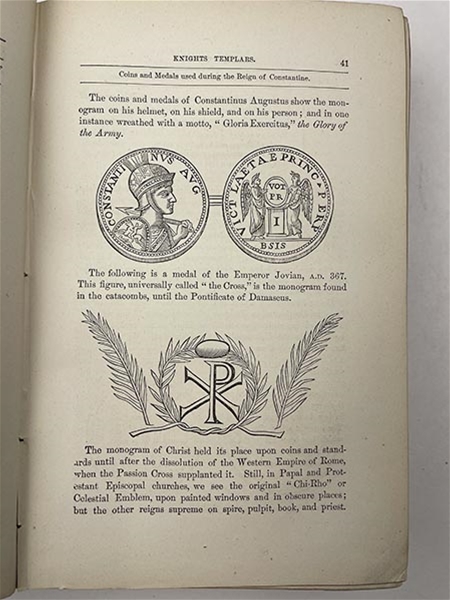
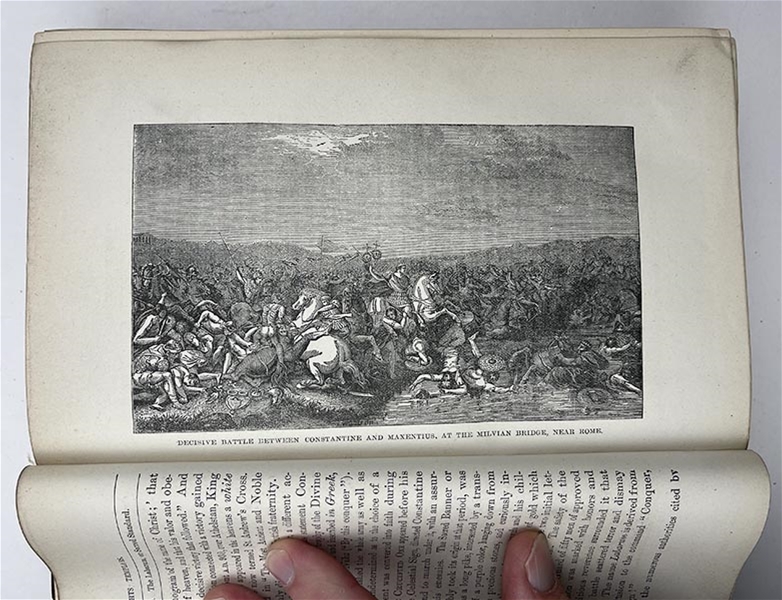
In Chapter III, Macoy spends significant time on Constantine’s vision and
the Labarum (the sacred standard).
- The
Claim: He points out a
"special service to the Masonic historian" by highlighting an
"error of form" in modern American Commanderies. He notes that
the original sign was the Chi-Rho monogram (X and P), not the
Passion Cross used on modern Templar flags.
- Significance: As we know symbols carry all sorts of meanings. Here is the Knights Templar symbol used today compared to The Chi-Rho monogram used by Constantine. It would be curious to understand what Masons today would take from each symbol?
The Three Actions for Modern Chivalry
1. Adopt the "Secret Discipline" of Discretion
In Chapter II, Macoy argues that the early Church succeeded because they
were "wise as serpents" and used a "Secret Brotherhood" to
survive a world that wanted to "stamp them out".
- Determine
what your most important goals are to build your “spiritual” temple. Keep these private and only share them
with people you trust.
- The
Goal: Build the "mysterious bond
of unity" in your own life by prioritizing deep, face-to-face trust
over public validation (social media posts, etc).
2. Guard Your "Labarum" (Your Standards)
Macoy details how Constantine’s "Celestial Sign" became a
standard that "scattered terror and dismay" through opposing forces
because it was guarded by a dedicated "Color-Guard" of fifty men.
- From
the goals you defined above, choose the two non-negotiable values (your
personal "Labarum") that you will march under this week.
- The
Goal: Don't just have values; guard
them. Find brothers in your commandry or lodge who won't let you lower your standard
when things get "calamitous".
3. Seek the "Sealed Fountain" (Intentional Study)
Macoy includes a striking engraving of "Solomon’s Sealed
Fountain" and notes that "the pathways to [the Holy Land]... have
been worn by the staves and the footsteps of pilgrims".
- Set aside "Sealed Time" for study—no phones, no screen time, no television, just you and a primary source.

- The
Goal: Modern life is a "lonely
desert," but intentional study is the "living water". Like
the pilgrims Macoy describes, you must put in the "body-bending
toil" to find the "authentic roots" of what you believe.
Macoy’s hand carved dies and prints hand printed on 1850’s Pre Press from Macoy’s book.
- Macoy Publishing & Masonic Supply has many of the hand carved dies used to print this book.
- 2.
We also have two presses from the late
1800’s that we can still make the hand prints from those dies.
- 3.
If you would like to purchase those
hand made prints and have a piece of history click here on our website.
- 4.
You can watch the videos of brothers
hand printing those dies on our website. Macoy Youtube Print playlist
- 5.
We also have other hand made prints
from Macoy’s Masonic Monitor and the Royal Arch you can purchase.
Shop Knights Templar Education & Jewels
Macoy Publishing & Masonic Supply specializes in the "Mastery of the Order." Explore our curated selection of Templar essentials:
- Knights Templar Illustrated: The definitive guide to Commandery ritual, history, and floor work.
- Templar Jewels & Pins: High-quality Cross and Crown pins and rank-specific jewels.
- Masonic & Templar Rings: Fine jewelry featuring the freemason logo and Chivalric emblems.
Why Macoy is the Intellectual Home of the Commandery
While other suppliers may focus on mass-produced clothing, Macoy Publishing & Masonic Supply focuses on the soul of the organization. Since 1849, we have known that being a Knight Templar is an intellectual and spiritual commitment. Our 175-year history as a publishing house means we offer the "Standard" by which others are measured. When you seek the truth behind the Templar cross, you turn to Macoy. We provide the tools to help you truly *understand* the Commandery, ensuring the light of Chivalry never goes out.
