

The Most Accepted Meaning and Definition of the Masonic Apron by American Freemasons.
Written by Steve McCall, Owner of Macoy Publishing & Masonic Supply.
Pictures taken at Macoy Publishing's library.
“I present you with this lambskin or white leather apron,
which is an emblem of innocence and the badge of a Mason, more ancient the Golden
Fleece or Roman Eagle, more honorable than the Star and Garter, or any other
order that could be conferred upon you, at this or any other future period, by
king, prince, or potentate, or any other person except he were a Mason, and in
the body of a Lodge and which , I trust, you will wear it with equal pleasure
to yourself and honor to the fraternity.”[i]
A version of this meaning or definition of the Masonic Apron
can be found in practically every monitor or manual of every Grand Lodge in
America. Most masons are required to memorize this in order to prove their proficiency
in the Entered Apprentice degree so they may be eligible to passed to the
degree of Fellow Craft.
Also, lodge officers must memorize this in order to properly
present the new brother with his Badge of a Freemason.
Where did this definition come from?
There is no one author of this common definition. It most
likely evolved from what Freemason’s were saying in their lodges in the 17th
centuries.
Manuscripts 1696 - 1720
The early Manuscripts like the Edinburgh Register House MS and
others between 1696 and 1720 do not mention the apron. Authors suggest that the
apron was part of the clothing of masons but meaning was primarily focused on
the working tools and such.
Anderson’s Constitutions 1723
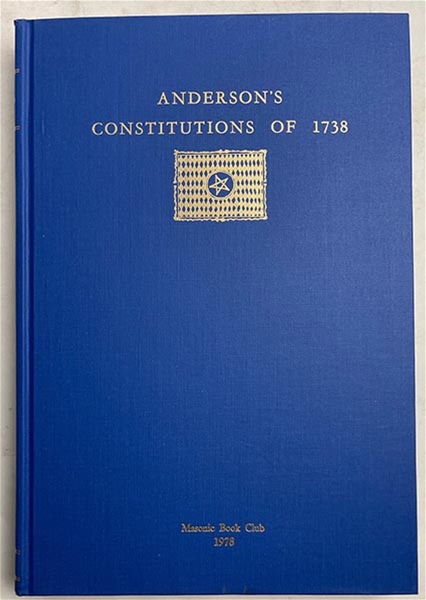
Dr. James Anderson’s Constitutions of Freemasonry
were adopted in 1723. In this document the apron received its official written
introduction to the Craft. It obviously
was part of the ritual before that date, but for the understanding of where the
paragraph about the apron memorized by so many American Freemasons, we will
start here.
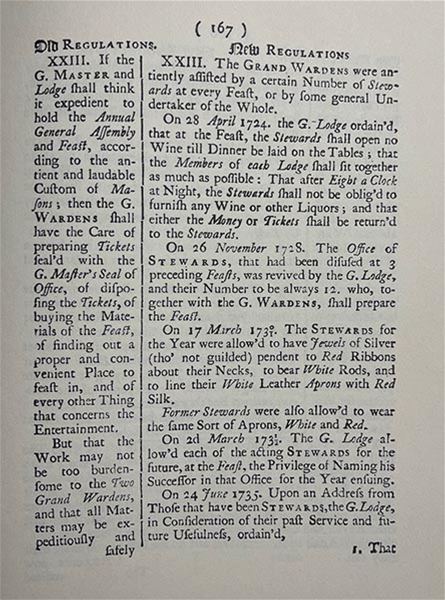
Anderson wrote:[ii]
“Every new Brother at his making is recently to cloath the
Lodge, that is, all the Brethren present…”
"...the said Masters and Wardens should also be enjoyn'd to come to the Grand Lodge in their white Aprons (viz. of white Leather)..."
Exposures:1730-1764
A dozen or so
exposures (unofficial ritual books) were published in the early 18th
century. One popular English expose, entitled Three Knocks (1760), says
this in the catechism (Most lectures of this time were catechisms).
“Master: What was
said to you then?
Answer: The Master called me up to the North-East Corner
of the Lodge, or at his Right Hand.
Master: Did he present you with anything?
Answer: He presented me with an Apron, which he put on
me; he told me that it was a Badge of Innocency, more antient than the Golden
Fleece or the Roamn Eagle; more honour’d than the Star and Garter, or any other
Order under the Sun, that could be confer’d upon me at that Time, or any Time
hereafter. “[iii]
Willaim Preston 1770
Preston developed the his lectures in the late 18th
century which included the moral application of many of our Masonic symbols
including the Masonic Apron.
As the many exposures began to surface in the mid 1700’s,
William Preston presented to Grand Lodge of England his versions of the
lectures of each of three degrees around 1772. These lectures became accepted
to most lodges, albeit slowly, through the last part of the 18th
century.
His definition and meaning of the Apron in the form of a
catechism:
“Q: What further mark of favour did he confer?
A: He commanded
the Senior Warden to invest the new brother the ancient clothing of a
Mason.
Q: What is that ancient clothing?
A: White gloves and a white leather apron
Q: What does it denote?
A: Purity
Q: What does it second denote?
A: Innocence
Q: How are they both considered?
A: Ensigns of the order of Masonry more ancient and
honorable than the ensigns of any other order and always to be worn by Masons
as the badge of innocence and the bond of friendship.
Q: What benefits is derived from this clothing?
A: We are kindly received into all assemblies of Masons,
and honored by them with the endearing name of a brother.
From the particular secrets with which we are entrusted
and the ancient clothing with which we are invested we secure the privileges of
confraternity; rank as brethren of one family; and act in unison for the
general will: thus from the clothing we bear we stamp our real value as members
of one household.”[iv]
Thomas Webb 1797
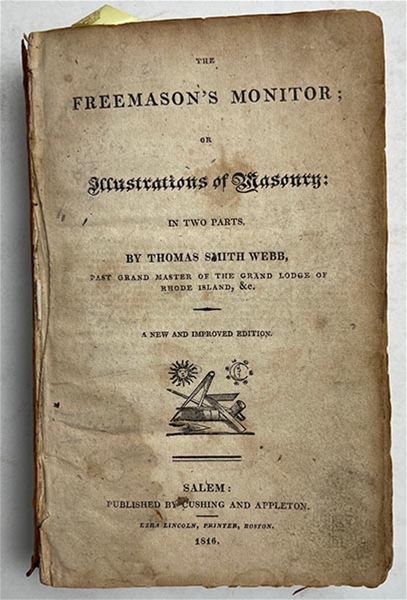
From Preston’s lectures, Thomas Webb developed the American
Ritual in 1797 in his The Freemason’s Monito: Or Illustrations of Masonry in
Two Parts.
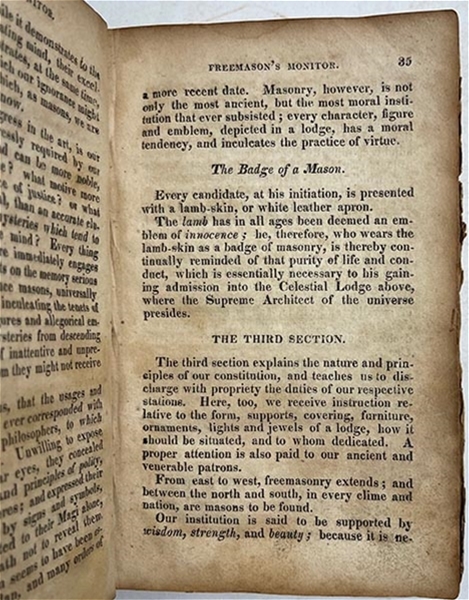
These quotes are from Webb’s 1816 monitor:
“The lambskin-skin, or white leather apron, which an
emblem of innocence, and the badge of a mason; more ancient than the golden
fleece or Roman Eagle; more honorable than the star and garter, or any other
order that could be conferred upon the candidate at that or any future period,
by king, prince, potentate, or any other person, except he be a mason; and
which every one ought to wear with pleasure to himself and honor to the
fraternity.”
The Badge of a Mason
“Every candidate, at his initiation, is presented with a lamb- skin, or white leather apron. The lamb has in all ages been deemed an emblem of innocence he, therefore, who wears the lambskin as a badge of masonry, is thereby continually reminded of that purity of life and conduct which is essentially necessary to his gaining admission into the Celestial Lodge above, where the Supreme Architect of the universe presides.”[v]
When did Grand Lodges in the United States start to use
this definition?
Many of the earliest Grand Lodges in America used versions
of The Ahiman Rezon prior to adopting the Webb/Preston work. Some states like
Pennsylvania never adopted the Webb-Preston ritual and their definition of the
Apron is different. Other Grand Lodges like Kentucky (Pirtle), Kansas (Shaver)
and Louisiana use the Webb definition but also have additional meanings
attached to the Masonic Apron.
Most Grand Lodges adopted the Webb-Preston work in the early
19th century. Webb and many of the brothers he taught were already teaching
the Webb/Preston ritual before it was officially adopted by the Grand Lodges.
More on the Meaning of the Masonic Apron can be found here:
The Badge of a Mason: A complete Guide to the Masonic Apron
Mackey’s exploration of the Masonic Apron
The Deeper Meaning of the Masonic Apron by Steinmetz
[i]
Mackey, Alber, Manual of the Lodge, New York, Macoy Publishing & Masonic
Supply, 1870, pp 31
[ii] Anderson,
John, Constitutions, 1723, London, pp 167
[iii]
Jackson, ACF, English Masonic Exposures 1760-1769, Cambridgeshire, Lewis
Masonic, 1986, pp 73
[iv]
Dyer, Colin, William Preston and His Work, Shepperton, Lewis Masonic, 1987, pp.
180
[v]
Webb, Thomas, The Freemason’s Monitor, Salem, Cushing and Appleton, 1816, pp.
35
